

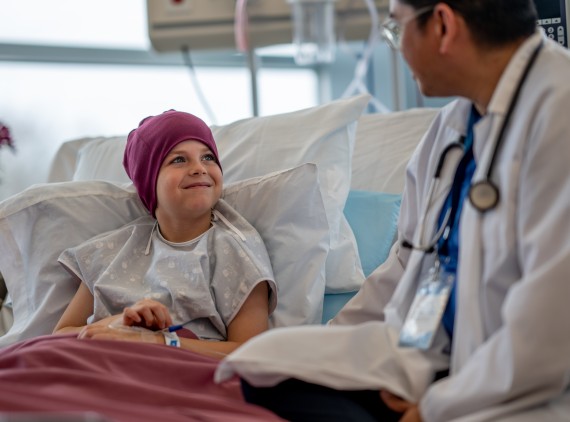


Hearing that your child has a brain or spinal cord tumor can be overwhelming. Families are often faced with many questions about the diagnosis, treatment options and what comes next. We're here to help you understand your child's diagnosis and the treatment options available.
At Phoenix Children's, we believe every child deserves a treatment plan designed specifically for them. Advances in precision medicine allow our team to better understand each child's tumor and use that information to provide the most personalized care possible.
"No two children – and no two tumors – are exactly alike," said Ross Mangum, MD, Section Chief of Neuro-Oncology Program at Phoenix Children's. "Precision medicine helps us understand what makes each child's tumor unique so we can make the best possible decisions about their care."
What Is Precision Medicine?
Learning more about your child's tumor helps us choose the treatment most likely to help. One way we do this is through precision medicine. Every tumor has its own unique genetic "fingerprint." By studying that fingerprint, doctors can learn more about how a tumor is likely to behave and which treatments may work best.
This personalized approach is called precision medicine. Instead of using the same treatment plan for every child with a similar type of tumor, we use information about your child's tumor to create a care plan that's right for them.
Sometimes this testing helps to identify treatments that may specifically target changes within the tumor. Other times, it helps doctors better understand how aggressive the tumor is or whether a child may benefit from more – or sometimes less – treatment.
Understanding Your Child's Tumor
After surgery or a biopsy, we carefully study your child's tumor to learn as much as we can about it.
In addition to examining the tumor under a microscope, we may perform specialized molecular testing to learn more about its biology. These tests help us:
- Confirm the diagnosis
- Better understand how the tumor is expected to behave
- Identify treatments that may be most effective
- Determine whether targeted therapies or clinical trials may be available
- Determine whether an inherited condition may have contributed to the tumor
"The more we understand about a child's tumor, the better equipped we are to develop a treatment plan that's right for that individual child," said Dr. Mangum.
Personalized Treatment Decisions
What we learn helps us recommend the treatment plan that's right for your child. For some children, surgery alone may be enough. Others may benefit from chemotherapy, radiation therapy, targeted medications or participation in a clinical trial.
"Not every tumor has a medication that specifically targets it," said Kazuhiro Sabet, MD, Pediatric Neuro-Oncologist at Phoenix Children's. "But the information we gain almost always helps us better understand the tumor and make more informed decisions about the best treatment for each child."
Researchers continue to discover new ways to understand and treat pediatric brain tumors. These advances are creating treatment options that weren't available just a few years ago.
"Some pediatric brain tumors remain among the most challenging diseases we treat," Dr. Sabet says. "But we have made tremendous progress. Every discovery brings us closer to better treatments, and that gives us hope for the future."
A Team of Experts Reviewing Every Child's Care
Children with brain and spinal cord tumors often benefit from the expertise of many different specialists.
At Phoenix Children's, complex cases are reviewed by a multidisciplinary tumor board, where pediatric neuro-oncologists, neurosurgeons, neuroradiologists, neuropathologists, genetic specialists and other experts meet to discuss each child's diagnosis and treatment options.
at Phoenix Children's so families can remain close to home while going through this difficult process. However, if another center offers a treatment or clinical trial that may benefit a child, we'll help families access those opportunities as well. We will always do what is in the best interest of the child."
Compassionate Care. Innovative Treatments. Hope for the Future.
Every child deserves care that is as unique as they are.
By combining advanced molecular testing, personalized treatment planning, leading-edge research and compassionate multidisciplinary care, Phoenix Children's is helping shape the future of pediatric neuro-oncology while providing families with the support they need today.
Whether your child has recently been diagnosed or you are seeking a second opinion, our team is here to help you understand your options and guide you through every step of your child's care.
Our specialists review imaging, pathology and molecular testing results together. This team approach helps us recommend the best treatment plan for your child.
For children who may benefit from proton beam therapy, we -collaborate with Mayo Clinic in Arizona to provide access to this highly specialized form of radiation treatment.
"One of the greatest strengths of our program is that no one physician makes these decisions alone," said Dr. Sabet. "Our team works together to review every piece of information so we can recommend the best possible treatment plan for each child."
Looking Ahead: The Promise of Liquid Biopsy
Phoenix Children's is also helping lead research into an exciting new technology called liquid biopsy.
Today, doctors primarily monitor brain tumors with MRI scans. Researchers are studying whether tiny pieces of tumor DNA that circulate in blood or spinal fluid could allow doctors to detect changes earlier than MRI alone.
"Our hope is that one day we will be able to detect changes in a tumor before they become visible on imaging or before a child develops new symptoms," says Dr. Mangum. "Although this technology is still being studied, it has tremendous potential to improve how we care for children with brain tumors."
Why Families Choose Phoenix Children's
Treating a brain or spinal cord tumor requires much more than medical expertise – it requires a team dedicated to caring for the whole child and supporting the entire family.
At Phoenix Children's, your child's care team may include pediatric neuro-oncologists, neurosurgeons, radiation oncologists, neurologists, endocrinologists, psychologists, rehabilitation specialists, nutrition experts, social workers, skilled nurse coordinators and many other professionals working together.
Families also have access to clinical trials, advanced molecular testing and access to new treatment options through our participation in national research collaborations, including the Children's Oncology Group.
"Our goal is to provide exceptional care while walking alongside families through every step of their journey," said Dr. Mangum. "We take pride in being able to offer this comprehensive care right here at Phoenix Children's so families can remain close to home while going through this difficult process. However, if another center offers a treatment or clinical trial that may benefit a child, we'll help families access those opportunities as well. We will always do what is in the best interest of the child."
Compassionate Care. Innovative Treatments. Hope for the Future.
Every child deserves care that is as unique as they are.
By combining advanced molecular testing, personalized treatment planning, leading-edge research and compassionate multidisciplinary care, Phoenix Children's is helping shape the future of pediatric neuro-oncology while providing families with the support they need today.
Whether your child has recently been diagnosed or you are seeking a second opinion, our team is here to help you understand your options and guide you through every step of your child's care.