

Share


When Laura’s son was 2 years old, he fractured his leg at the playground. When he was 4, he experienced another fracture at a trampoline park. He had trouble with his balance. His mom noticed a slight limp when he ran. Friends and family members told her not to worry – but she knew something wasn’t right.
Laura took her son to Phoenix Children’s, where he was seen by orthopedists, rheumatologists, endocrinologists and neurologists. Each specialist brought new hope and new questions. The case was complex and the pieces didn’t fit neatly together. As the search for a root cause continued, the fractures kept happening. With every new test, every new appointment, every new blood draw, her son also developed an intense fear of needles. That fear grew deeper with each difficult experience.
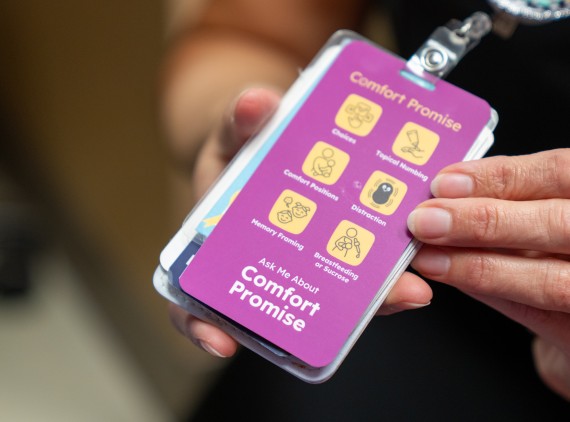
Five years later, her son, now 9, has a dedicated team of specialists at Phoenix Children’s by his side. He also no longer fears needles, thanks to nurses who used tools and interventions to turn blood draws into positive experiences. Today, these tools and interventions are called Comfort Promise, a bundle of evidence-based steps designed to reduce pain and anxiety during needle sticks. Getting to that point was its own journey, one that required patience, persistence and a different kind of care.
Past needle-stick trauma
Initially, Laura took her son to get bloodwork done outside of Phoenix Children’s.
“Those experiences were awful,” Laura said. “When we went the first time, my son said he was scared. And the lady said, ‘I know you’re scared, but I have to leave in 10 minutes and need to do your bloodwork.’ That’s not OK.”
Laura was instructed to hold her son. No one talked him through what was happening. During the needle stick, he screamed the entire time.
“It scared him,” Laura said. “He never wanted to go back again.”
However, they had to go back again. Every time it was the same: The feeling of dread on the car ride there. The buildup of emotions while sitting on a parent’s lap. Then, the breakdown: the screams and the tears. Each visit was more traumatizing than the last and for Laura, every blood draw was heartbreaking to witness, especially knowing it had to happen again.
The importance of compassion
Eventually, Laura learned that blood draws could be done at Phoenix Children’s. Even there, those early visits were a struggle. Her son’s trauma from outside facilities had already taken root, and though staff gave him more time and patience, the fear didn’t disappear overnight.
“At that point, he’d already had so many bad experiences,” she said.
Everything changed when they met Fernando. When her son said he was scared, Fernando got down to his level and offered something different. “It’s OK to be scared, but you can be brave, too,” Fernando said.
The first blood draw took an hour. Fernando didn’t care. He took his time, talked her son through every step, tried different distractions, including the Buzzy, a device that vibrates and can be used as a cold pack to help with numbing. He even offered incentives. He told stories about himself as a kid, the kind that put her son at ease and made the lab chair feel a little less frightening. When the draw was finally done, Fernando told Laura to keep coming back. “He’s going to get better. He’s just had really bad experiences.”
Her son needed blood drawn every few months, sometimes more often. They kept going back to Fernando, and each time, something shifted. Fernando would tell him: “You can cry, but each time you come here, you will be braver, even though you’re scared now.” An hour became 20 minutes. The tears grew quieter. The chair felt less like a threat.
One day, Fernando wasn’t there. A woman was filling in, and at first, her son was nervous. The good news is, she used the same approach – choices, comfort positions, distraction techniques, memory framing, which helps children frame the experience positively and improve future needle sticks. When she finished, he told his mom the needle stick didn’t hurt, just like Fernando’s needle sticks.
The real milestone came a few weeks later, when the family had an appointment at a different Phoenix Children’s location and Fernando wasn’t an option. Her son was uncertain, but he thought of what Fernando had told him.
“Fernando tells me I could be scared, but I could be brave,” he said.
The draw took 10 minutes. No screaming. No tears. Afterward, he couldn’t wait to get back to tell Fernando he’d done it without him.
Courage in the face of self-injections: The power of memory framing
Around the same time, Laura was introduced to Phoenix Children’s new Comfort Promise initiative. Many of the tools Fernando and others had been using for years were formalized in the program. However, one piece was new to Laura, a suggestion for what parents can do after a procedure. It asks parents to invite their child to reflect: What did they do better? What are they proud of?
After her son’s next blood draw, she tried it. After telling him how proud she was, she asked, “What do you think you did better?”
“I didn’t cry at all,” he said. “I was scared, but I can be brave. I didn’t look, but I know that I can do this now. I did really good today.”
Today, her son gives himself injections at home. Getting there required the same kind of patient, compassionate care that had transformed his blood draws. His nurse, Sandra Ruiz Suarez, spent more than an hour with him, walking through the steps, letting him practice, using Comfort Promise tools and making space for his fear without letting it stop him. When he couldn’t bring himself to do it, she sat beside him and held his hand.
“He was so scared of these shots because of all of his trauma before,” Laura said. “But this nurse was so patient with him. It was amazing. She told him it’s OK to be scared. She tried the Buzzy. She talked to him. She asked him questions. She was so compassionate.”
Finally, he gave himself a shot. He looked at Sandra, said “thank you” and gave her a huge hug.
“Moments like this remind me of why I became a nurse,” Sandra said. “The hug after the injection honestly came as a welcome surprise. In that moment, I could feel the patient’s tension leaving him after facing a stressful situation.”
Sandra said it’s always rewarding when a patient can participate in their own care.
“In cases like this, I like to take my time when going over the teachings, and I like to involve the patient in their care as much as I can so that they feel comfortable with the steps and plan,” Sandra said. “I encourage questions at any moment and share insights from other patients when appropriate. I also offer the Comfort Promise tools for additional comfort.”
“I love getting to see their eyes light up when they learn something new or when they gain the courage to face their fears,” she said.
Comfort Promise: Now offered to every patient, every time
Laura’s son no longer dreads bloodwork.
“The Comfort Promise techniques and tools have been a wonderful addition to our clinics and floors,” Sandra said. “The tools help take the focus away from something that may otherwise be causing fear and stress to build up. I love that we are given a variety of comfort measures to choose from.”
She also noted that patients and parents appreciate the Comfort Promise techniques because they put patients at ease and help them feel more comfortable during their clinic visits.
“Comfort Promise made my child realize that it’s OK to be scared, but you can be brave, too,” Laura said. “It made him realize that he’s not alone and that there are people who care about him. Comfort Promise makes kids feel comfortable. It makes them feel welcome. It makes them feel like they belong.”