Didactics

Weekly Schedule

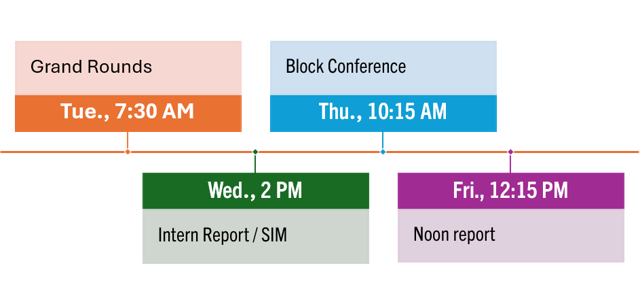
Graphic of education schedule

Academic Block Conference

Thursday AM/PM

  • 3-hour protected educational session during which all residents are excused from clinical duties, regardless of training site, to come together for dedicated learning focused on core pediatrics and becoming well-rounded pediatricians.
  • 18-month recurring curriculum organized around monthly themes covering core pediatric topics, clinical skill development, board preparation, advocacy, patient safety and quality improvement.
  • Quarterly Class-Specific Sessions: Residents separate by class for targeted education and professional development, including Residents as Educators, presentation skills, financial wellness and other topics relevant to each stage of training.

Patient Safety

Monthly resident-led sessions during Academic Block Conference use real patient safety events to explore clinical decision-making, systems-based practice and opportunities for process improvement.

HEAL Curriculum

Resident-led sessions during Academic Block Conference  to explore health disparities, equity, root causes and opportunities for meaningful change.

Grand Rounds

Tuesday AM

Weekly hospital-wide educational conference featuring speakers and topics relevant to pediatric medicine, healthcare and professional development.

Intern Report

Wednesday PM

Weekly PGY-1-led, case-based conference using a Pedi-Puzzle format to work through a clinical case, develop a differential diagnosis and strengthen clinical reasoning.

Noon Report

Friday 12PM

Weekly PGY-3-led conference covering a variety of educational topics and formats, including Pedi-Puzzle clinical cases, HEAL sessions and patient safety discussions.

Simulation & POCUS 

  • Weekly simulation and procedural skills sessions at Valleywise Health for PGY-1 and PGY-2 residents, with additional simulation experiences incorporated throughout other rotations.
  • Quarterly hands-on POCUS sessions provide residents with faculty-guided ultrasound practice and exposure to foundational point-of-care ultrasound applications.

Board P.A.S.S. Program

We recognize that learning, retaining information and preparing for board certification are highly individualized. Our program provides a range of resources and personalized support to help residents build strong study habits, identify knowledge gaps and prepare for the American Board of Pediatrics certifying exam.

Board P.A.S.S.

(Personalized Assessment & Support for Success) 

Board P.A.S.S. (Personalized Assessment & Support for Success) is a structured program offering individualized coaching, study resources and longitudinal progress tracking for all residents.

Resources throughout residency:

  • AAP PREP: 
    • Board-style questions with explanations and references through complimentary AAP membership. Monthly PREP question tracking is incorporated into Board P.A.S.S.
  • Hippo Education Peds Board Review:
    • 15 months of complimentary access, including 150+ hours of lectures, an adaptive Qbank with 1,250+ questions and the Peds RAP podcast
  • Senior Resident Board Review:
    • Focused board preparation during Thursday Academic Block Conference from April through June of PGY-3 year
  • MedStudy:
    • Complimentary access for interns, with the MedStudy Qbank available to PGY-3 residents

Assessment & Individualized Support

In-Training Examination (ITE): Administered annually each July to help residents track their progress, identify areas for growth and guide individualized study plans. Results also help the program identify opportunities to strengthen the curriculum.

Library & Educational Resources

  • American Academy of Pediatrics Membership: Complimentary membership with access to Pediatrics in Review, PREP questions, Clinical practice guidelines, Patient education materials, Additional AAP resources.
  • Medical Library Access: Residents have access to medical libraries and librarian support through Phoenix Children’s, Valleywise Health and the University of Arizona College of Medicine – Phoenix. Librarians assist with clinical questions, literature searches, research and access to online and print resources.
  • Educational Funds: Additional board review materials and courses may be reimbursed through resident educational funds.

Resident Research

All residents participate in annual quality improvement projects through continuity clinic, with additional opportunities to pursue clinical research and other scholarly work throughout residency.

Phoenix Children’s offers a broad range of resources to support resident and fellow scholarship, including:

  • Dedicated medical education research support for project design, IRB navigation, basic statistics, manuscript preparation and poster development
  • Medical librarians and biostatistician services
  • Resident research funding, including the Learner Research Fund with up to $15,000 available for eligible projects
  • Funding to present research at regional and national conferences
  • Support with grant applications, data requests and IRB processes
  • A Residency Scholarship Oversight Committee that provides mentorship, resources and longitudinal support for residents completing research, quality improvement, or other scholarly projects 

Residents interested in research can work with faculty mentors across a wide range of pediatric specialties, with support available from project development through presentation and publication.