

What is a Cleft Lip & Cleft Palate?
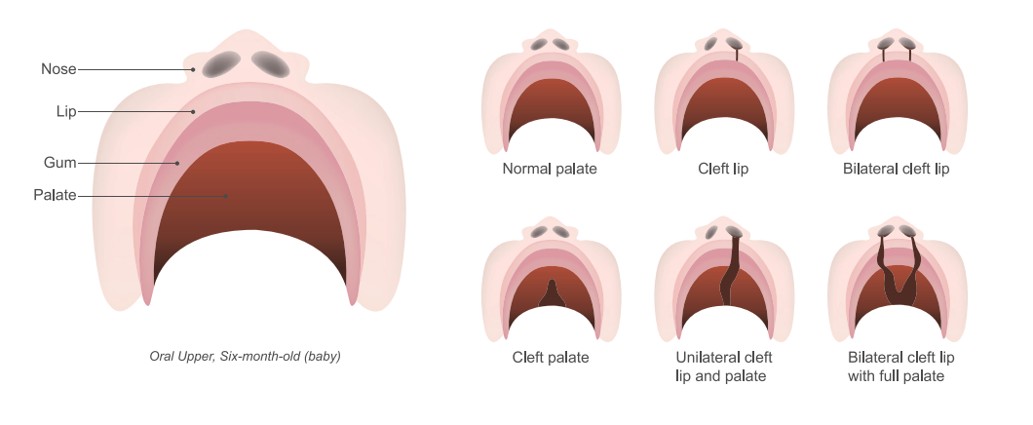
Cleft lip is a separation in the lip that happens when the lip does not form completely before birth. Normally, the tissues that make up the lip join between the fourth and seventh weeks of pregnancy.
A cleft lip can range from a small notching in the lip to a large opening from the lip up through the nose. It may appear with or without a cleft palate.
A cleft palate is a gap in the roof of the mouth that happens when the tissue that makes up the roof of the mouth, called the palate, does not join completely before birth. The palate usually forms between the sixth and ninth weeks of pregnancy.
A gap in the mouth can extend from the front of the mouth (hard palate) to the throat (soft palate) and may include the lip. It’s common for people to have both a cleft lip and a cleft palate.
How Common is a Cleft Lip & Palate?
About 4,440 babies are born with a cleft lip and 2,650 babies are born with a cleft palate each year in the United States. Cleft lip and cleft lip with a cleft palate are more common in boys than girls. But a cleft palate without a cleft lip is more common in girls. Nationally, cleft lips and cleft palates are also most common among Native Americans and least common among African Americans.
What Are the Effects of a Cleft Lip or Cleft Palate?
Having a cleft lip can affect a person’s physical appearance and their tooth structure, as well as feeding and speech. A cleft palate that occurs without a cleft lip does not affect how the face looks but can affect other functions such as feeding and speech. Commonly associated with a cleft condition are chronic ear infections, feeding difficulties, food and formula coming through the nose, and speech delays.
How to Feed a Baby with a Cleft Palate
Babies with a cleft lip or palate often require special feeding options and positioning to help them get the nutrition they need to grow. At Phoenix Children’s, you’ll work closely with your child’s feeding therapist and medical team to find the feeding option that works best for your child.
What Causes a Cleft Lip & Palate?
Many times, we don’t know the cause of a cleft lip or palate. Both genetic and environmental factors can play a role but not always. A baby is at a higher risk of being born with a cleft lip if the pregnant person:
- Has a family history of cleft lip
- Smokes cigarettes, drinks alcohol or takes certain medicines during pregnancy
When is a Cleft Lip or Palate Diagnosed?
A cleft lip is usually noticed right away after birth. It may be diagnosed before birth through a routine ultrasound, but a cleft palate without a cleft lip is more difficult to see using ultrasound.
How Do You Treat a Cleft Lip & Palate?
Treatment for cleft lip and palate is not a single procedure but a journey that unfolds over time. At our center, care often begins before your child is born. Through our prenatal program, we partner with families early, providing education, emotional support and a clear path forward, so you never feel alone at any stage.
Your cleft team monitors your child’s growth, development, function and appearance. Regular evaluations help us identify concerns early and recommend supportive therapies or additional treatment, all in alignment with the American Cleft Palate-Craniofacial Association (ACPA) Parameters of Care. Treatment plans are unique to each child and may include:
- Feeding education
- Plastic and reconstructive surgery
- Speech and language evaluation and therapy
- Behavioral health services
- Dental and orthodontic care
- Alveolar bone grafting
- Monitoring of facial and jaw growth
- Revision or secondary surgery
- Additional specialty care
Learn more about the different services we offer at each stage of development.
Download the Cleft Lip and Palate Treatment Guide.
In the earliest stages of care for infants with cleft lip and/or palate, our focus is:
- Providing education
- Offering family support
- Helping your baby thrive
- Giving clear guidance
- Answering questions
We also support early interventions that help optimize your child’s anatomy in preparation for surgical correction of the cleft lip and, later, the cleft palate. Through this evidence-based, step-by-step approach, we aim to ensure your baby is healthy, strong and well-prepared, and your family feels supported and informed throughout the process.
During the first year we offer:
Feeding Education
Through Speech-Language Pathology, we offer a personalized feeding evaluation and treatment to build confidence in caring for your child at home. Care focuses on developing successful feeding skills using specialty bottles and strategies specific to your baby’s diagnosis.
We work with your baby’s pediatrician as needed to provide the best feeding plan at each stage of development during the first year, which is essential to your baby’s growth and readiness for the next steps in treatment.
Facial Molding with Craniofacial Orthodontics
Improvement in facial symmetry and balance can benefit many infants. In those with a cleft lip, we can gently reshape the gums, lip and nostrils during the earliest months of life, when these tissues are most responsive to molding.
Nasoalveolar Molding (NAM)
Nasoalveolar molding (NAM) is a gentle, non-surgical treatment for babies born with cleft lip and/or cleft palate. We start it within the first few weeks of life to help shape the gums, lip and nose before cleft repair surgery.
First, we fit a custom-made molding plate inside your baby’s mouth to gradually guide growth and improve alignment. Then, during regular visits, we adjust the plate as needed.
Starting early takes advantage of your baby’s natural flexibility during the newborn period. This process can help:
- Reduce the width of the cleft
- Improve nose symmetry
- Support better surgical results
Nasolabial Molding (NLM)
Nasolabial molding (NLM), also called “taping and stenting,” is a gentle, non-surgical treatment for newborns with a cleft lip. Like nasoalveolar molding, we start it within the first few weeks of life to help improve lip position and nose shape before cleft repair surgery.
Treatment begins with us placing stretch tape across the cleft to bring the lip segments closer together, which helps center the nose. After a few weeks, we may add a small, removable nasal stent to improve the shape of the flatter nostril. It’s important to only tape and stent as directed. Your care team is here to guide you at every step.
An early start with nasolabial molding takes advantage of your baby’s natural flexibility during the newborn period. The process can help:
- Narrow the cleft
- Improve facial symmetry
- Support better surgical results
Behavioral Health Services
In the first year of life, families caring for an infant with cleft lip and/or palate often face emotional, practical and unexpected challenges. Integrating behavioral health services from experienced therapists and social workers provides an additional layer of support during this critical time.
These specialists offer a space for families to process concerns, navigate stress and build coping strategies, while also helping address practical needs such as accessing resources and coordinating care.
By supporting the emotional well-being of caregivers, behavioral health services strengthen the entire care environment around the child. Families who feel supported and confident are better equipped to manage feeding routines, attend appointments, engage fully in their child’s treatment plan and prepare for surgical intervention.
Plastic & Reconstructive Surgery
A plastic surgeon typically performs surgical correction of the cleft lip within the first six months of life. We often perform cleft palate correction surgery in the second six months of life. Your child receives both procedures under general anesthesia, which keeps them safe and comfortable.
Following lip surgery, most healthy infants can return home the same day. Palate surgery usually involves a short hospital stay of one to two nights. Recovery typically takes about two weeks, though this can vary for each child.
Additional Specialty Care
During the first year of life, additional specialists play a supporting role in making sure your child gets all the care they need, while reducing the day-to-day burden on families.
- Audiologists perform early and ongoing hearing assessments to ensure that we identify any hearing loss and manage it right away.
- Nursing and care coordination teams assist families with navigating appointments, education and access to resources.
- Otolaryngology (ENT) providers monitor ear health and middle ear function, placing ear tubes (tympanostomy tubes) when needed to help prevent fluid buildup and support hearing development.
- Your pediatrician oversees your child’s general health.
Our team remains engaged with you and your child during early childhood, which is usually ages 1-5. We focus on age-appropriate development, offering the following services:
Speech-Language Pathology
During early childhood, your child’s speech-language pathologist’s role changes. Instead of focusing on feeding evaluation and therapy, they focus on speech and language skills.
Speech-language pathologists monitor and support communication development in children with cleft lip and/or palate by:
- Evaluating early speech and language milestones and recommending therapy as needed
- Evaluating nasality or resonance and palate function for speech and identifying concerns, such as abnormal speech patterns or conditions that affect how speech sounds, such as velopharyngeal dysfunction
- Providing targeted therapy to help establish clear, age-appropriate communication skills
They also work closely with families, offering strategies to encourage speech and language development in the home environment.
Craniofacial Orthodontics & Pediatric Dentistry
Craniofacial orthodontists and pediatric dentists support healthy oral development in preparation of future dental and skeletal growth. During early childhood, they monitor tooth eruption patterns, manage dental alignment and address developing bite relationships.
Pediatric dentists focus on oral health prevention and maintenance to keep dental structures protected and functional.
Craniofacial orthodontists may introduce early orthodontic interventions when needed to guide growth and enhance conditions for future treatment stages.
Behavioral Health Services
Behavioral health providers, including psychologists, therapists and social workers, support the emotional and psychosocial well-being of children and families throughout early childhood. They help families navigate developmental transitions, social adjustment and the ongoing demands of multidisciplinary care.
Services may include help with coping skills, parent-child bonding, behavioral development and school readiness.
Plastic, Reconstructive & Maxillofacial Surgery
Plastic surgeons continue to play a key role in early childhood by monitoring facial growth, surgical outcomes and functional development following your child’s initial cleft lip and/or palate repair. They assess the need for any secondary or staged procedures that may support speech, facial symmetry or function as the child grows.
Your surgeon works with your full care team to ensure that any decisions are thoughtful and developmentally appropriate.
Additional Specialty Care
Other specialties help children ages 1-5 get the complete care they need, including:
- Audiologists work closely with the team to perform regular hearing evaluations to identify and address any hearing loss early.
- Nursing and care coordination services help families navigate appointments, provide education and ensure continuity across specialties.
- Otolaryngology (ENT) providers monitor and manage middle ear function and hearing, which are commonly affected in children with a cleft palate. Your ENT may place ear tubes (tympanostomy tubes) when needed to support hearing and speech development.
- Pediatricians remain critical for the overall health of your growing child.
For school-aged children, typically ages 6-11, we offer these services:
Speech-Language Pathology
During the school-age years, speech-language pathologists continue to monitor and support speech clarity, resonance and overall communication effectiveness. They pay extra attention to speech sound and voice characteristics that may affect communicating in academic and social settings.
Some children experience changes to their bite (dental occlusion), which can affect speech. They may need therapy to improve speech precision and confidence. We work with families and schools so that these skills carry over across environments.
Ongoing evaluation helps determine whether your child will need additional surgery to improve speech outcomes.
Craniofacial Orthodontics
Coordinated dental care is important for both function and facial development.
Craniofacial orthodontists are involved when your child has both baby and adult teeth (the mixed dentition period). They help guide permanent teeth coming through the gums (dental eruption) and support proper alignment of the teeth and jaws. They also monitor growth and development closely.
Your child may need a surgery to repair missing bone in the upper gum (alveolar bone grafting). If they do, the orthodontic team will begin arch form preparation for the future surgery. They may recommend orthodontic treatment, using expanders and limited braces to address crossbites, spacing concerns or arch form issues common in children with cleft conditions.
Pediatric dentists continue to maintain preventive oral health care and manage any dental disease, ensuring a stable foundation for orthodontic and future surgical planning.
Behavioral Health Services
Behavioral health providers support children and families as they navigate school, social development and evolving self-awareness during the school-age years. Services focus on:
- Addressing medical anxiety and challenges related to increased care needs
- Addressing any challenges related to peer relationships
- Building coping skills
- Supporting self-esteem
- Supporting families in managing the emotional aspects of long-term multidisciplinary care
These services help promote resilience, healthy identity development and successful participation in school and community life.
Plastic, Reconstructive & Maxillofacial Surgery
Plastic surgeons continue longitudinal care during this period by monitoring facial growth, surgical outcomes and functional development following initial cleft repairs. They also evaluate the need for secondary procedures, such as revisions to improve speech function, nasal symmetry or facial balance.
Maxillofacial surgeons may be involved with removing teeth (extractions) to support orthodontic and surgical needs.
If your child’s cleft extended through the gum line (alveolus), we may recommend bone graft surgery between 5-8 years of age. This surgery can help support teeth as they come through the gums, stabilize the upper jaw and improve long-term dental health.
We carefully time all surgical plans with the full team to align with growth and developmental milestones.
Additional Specialty Care
Additional specialties continue to support the complete care your child needs during the school-age years:
- Audiologists perform ongoing hearing evaluations to make sure your child can hear during critical academic development.
- Care coordinators and nursing staff assist families in managing the increasing complexity of multidisciplinary appointments and school-based needs.
- Otolaryngology (ENT) providers monitor ear health, hearing status and airway function, addressing persistent middle ear disease or hearing loss that can impact speech and learning.
- Pediatricians remain critical for monitoring overall health during this rapid time of development.
For adolescents, typically ages 12-18 and older, we offer these services:
Speech-Language Pathology
During early and late adolescence, speech-language pathologists continue to help refine speech clarity, resonance and communication effectiveness.
For some teens, articulation errors or mild resonance differences may persist or emerge as growth changes that affect how the upper and lower teeth meet. Clinicians will evaluate whether speech is stable or if there’s a need for further behavioral, prosthetic or surgical intervention.
For jaw surgery (orthognathic surgery) candidates, speech-language pathologists will assess the risk of developing hypernasality as the upper jaw moves forward. They will monitor your child after surgery and recommend therapy or surgical support based on any speech challenges they observe.
Your child also may receive support to help them communicate well in increasingly complex environments, including academic, social and vocational settings.
Craniofacial Orthodontics & Pediatric Dentistry
Orthodontic care during adolescence focuses on completing treatment, including alignment of the permanent adult teeth, coordination of the upper and lower jaws, and preparation for jaw surgery if needed.
How and when we plan treatments depends on facial growth. Treatment may require pre-surgical orthodontics or refinement of how the upper and lower teeth touch (occlusion) following previous interventions.
General dental care continues to emphasize long-term oral health, prevention, tooth replacement and dental restoration as needed.
Behavioral Health Services
Behavioral health providers support adolescents as they navigate identity formation, social relationships and increasing independence. Services may address body image concerns, self-esteem, peer interactions, anxiety, and adjustment to ongoing or final stages of treatment.
Support may also extend to transition planning, helping adolescents take a more active role in their care.
Plastic, Reconstructive & Maxillofacial Surgery
As children mature, differences in upper and lower jaw growth can become more noticeable. Some teens may benefit from orthognathic (jaw) surgery in late adolescence or early adulthood to improve bite alignment, chewing function, speech support and facial balance.
Plastic, reconstructive and maxillofacial surgeons work closely with you, your child and the full care team to understand the need or desire for any secondary or definitive surgical procedures. Some people choose or benefit from additional procedures to improve:
- Appearance
- Breathing
- Jaw alignment
- Lip or nasal symmetry
- Scar contour as the face grows
We carefully coordinate surgical planning with all providers to improve both functional and aesthetic outcomes. Care remains highly individualized, with an emphasis on long-term stability. We want your child to achieve their goals and build the skills and confidence they need to gradually transition toward independent management of their care.
Additional Specialty Care
Additional specialists continue to contribute during adolescence to support comprehensive cleft care:
- Audiologists provide continued hearing surveillance to ensure ideal hearing function, particularly in academic and social settings.
- Nursing and care coordination services assist adolescents and families in managing increasingly complex treatment plans, transitions between pediatric and adult care, and scheduling across multiple specialties.
- Otolaryngology (ENT) providers monitor ongoing ear health and hearing stability. They also address persistent middle ear disease or hearing concerns that may affect communication and quality of life.
Transition from pediatric to adult care is an important phase for those with cleft lip and palate or other craniofacial differences. Though your child completes many aspects of treatment during adolescence, some continue to benefit from ongoing care related to speech, hearing, dental and orthodontic needs, facial growth, jaw alignment, nasal concerns and psychosocial support.
Our team provides adult cleft and craniofacial services and can continue to support your child through adulthood.
Transition planning includes helping patients understand their medical history, develop independence in managing their healthcare and connecting with appropriate adult providers. For those who relocate or move away, we can also assist in identifying a cleft or craniofacial team, or selecting individual providers, to ensure care continues with ongoing support.